  The DC-3 Society Presents: A Night Fright CommemorativeWe have a special treat for YOU, DC-3 Society Members! I have the privilege of presenting to you a very special edition of the DC-3 Society Newsletter. We are showcasing a restoration project dear to our hearts - though ALL DC-3s are! - but one that has been a long time in coming. Our AOO crews understand vividly the blood, sweat, and tears that go into saving our beloved Gooneys. I do not, however, believe there has been a restoration so thoroughly catalogued before. Among our Daks, Night Fright is one of the most decorated veterans, and her crew part of the very foundations of the DC-3 Society. Charlie Walker is chair of maintenance of the Society, and the crew is always willing to reach out for those still getting on their feet when undertaking a restoration. Historian Adam Estes, after a collaborative meeting between Charlie Walker, Neil Jones, Lyndse Costabile, and myself, has written a definitive primer on the aircraft, which we are sharing in full below. The road to flight, which involved, well, literal roads, shipping containers, ocean travel, and a hurried departure from Coventry, is just a slice of this DC-3's life; like her sisters, she wore many hats in service to humanity, be it the liberation of war-torn Europe or shuttling around small-town Southerners. (To us, she's still lovingly called the Tidewater Pacemaker.) And don't forget the chickens. I want to give a generous thank you to Charlie and Neil for their time in sharing their stories with us; to Adam Estes for the incredible article; to guest writer Chris Runge, Martha Morford, and Alan Hardwick for his photos of Night Fright after her arrival at Sywell Aerodrome. Be sure to check out the latest issue of Aeroplane Magazine for additional coverage of the restoration and flight. Visit Night Fright's official website at this link. I also would like to wish everyone a happy and safe 2026 EAA AirVenture, and please visit the Grand Old Ladies of the Society in the Vintage and Warbirds sections! They would love to see you. Rock those wings at Fisk! Blue skies, Savannah Bess Send your news, photos, questions, comments, and everything in-between to globalmedia@dc3society.org  Night Fright's Journey Back to the Airby Adam Estes The online commerce site eBay is typically not the first place one would look to find an airplane, let alone a WWII combat veteran aircraft, but aircraft engineer Tom Woodhouse had been asked to find an airplane that had once flown from RAF Membury, now part of the grounds of the Membury Estate, during the D-Day Invasion. Woodhouse was hired by the estate’s owners, the Walker Family, to find a Douglas C-47 Skytrain connected by history to Membury so as to have it returned to the former WWII airfield turned industrial park and gliderport and stand as a memorial to the young men who flew from this field on the night of June 5, 1944, bound for Normandy. Yet a member of the family, Charlie Walker, who is a commercial pilot, thought perhaps not only could they find an aircraft ready for display, but perhaps one that could be made airworthy again. 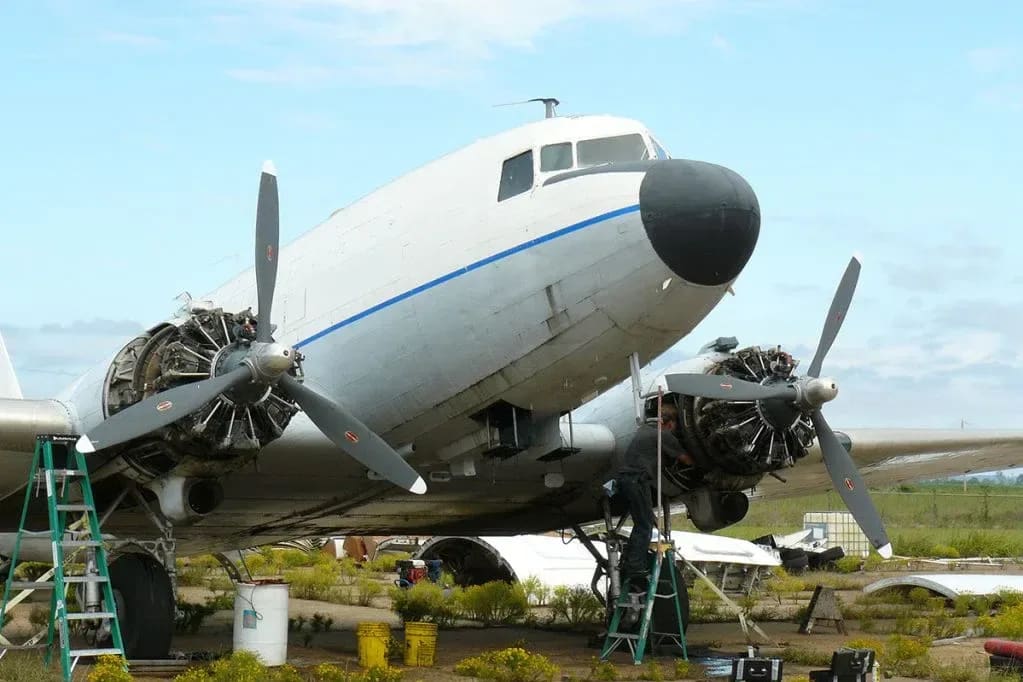 Derelict condition in Walnut Ridge, Arkansas  N308SF taxiing at Walnut Ridge 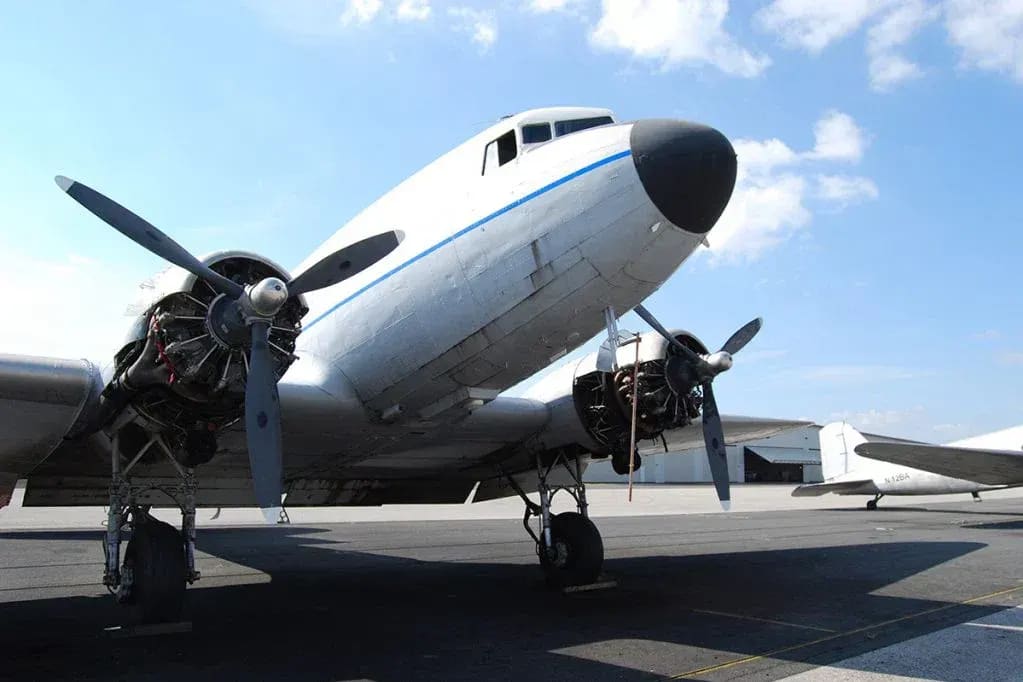 After arrival in Punta Gorda, Florida Tom and Charlie scoured any avenues where they could find such an aircraft that met their criteria, but once they had decided to look for any airplanes on eBay, they found an old DC-3 with the American registration N308SF sitting at Walnut Ridge Regional Airport, in the northeastern part of Arkansas, some 4,300 miles from Membury. Wearing a nondescript white and grey scheme with blue trim, the aircraft had changed hands many times after WWII, and lived many lives from military transport to airliner to freighter, but with the help of historian Roger Day, author of Membury at War: A Wartime History of Membury Airfield, Berkshire, it was confirmed that N308SF was indeed one of the last surviving C-47s that had flown from RAF Membury on D-Day, a C-47 known as Night Fright. But as Charlie and Tom worked to secure N308SF from an uncertain future, they also began to unravel her past and her ties not only to RAF Membury, but also to the latter half of the Second World War’s European Theater of Operations.  Night Fright leading a flight of three to Italy Like thousands of C-47s, the airplane that would become Night Fright began life on the assembly line of the Douglas Aircraft Company’s factory in Long Beach, California as C-47A-65-DL construction number 18954. On November 2, 1943, the aircraft was delivered to the United States Army Air Force as 42-100521. In December 1943, it was assigned to the 79th Troop Carrier Squadron, 436th Troop Carrier Group, and flown to Morrison Field (now Palm Beach International Airport/President Donald J. Trump International Airport) in West Palm Beach, Florida to prepare for its flight across the Atlantic to serve in the European Theater of Operations. While many American aircraft that would be assigned to the ETO came through the North Atlantic ferry route, 42-100521 would be assigned to fly through the South Atlantic ferry route and the North African ferry route. The three-man crew that would fly 42-100521 from Florida to England via the South Atlantic route included 1st Lt. William K. Watson as pilot-in-command, 1st Lt. Frank P. Bibas as acting copilot, and 2nd Lt. Arthur E. Thornton as navigator. On December 27, 1943, the men took off from Morrison Field, and made refueling stops through the Caribbean and South America at Borinquen Field (now Rafael Hernández Airport) in Aguadilla, Puerto Rico, Atkinson Field (now Cheddi Jagan International Airport) near Georgetown, British Guiana (now Guyana), Val-de-Cans Airport in Belém, Brazil, and Ibura Airport in Recife, Brazil before departing Recife for the British-held Ascension Island in the middle of the South Atlantic Ocean, landing at RAF Ascension Island (nicknamed Wideawake Field) on January 1, 1944. From Ascension, 42-100521 would resume its trek to Europe on the North Africa ferry route, flying to Roberts Field in Harbel, Liberia, then Eknes Airfield at Rufisque, near Dakar, Senegal, and Menara Airfield in Marrakech, Morocco. From Menara, they then had to fly nonstop to RAF St. Mawgan near Newquay, Cornwall, flying over the Bay of Biscay while keeping a vigilant watch for Junkers Ju 88s outfitted as long-range heavy fighters operating from Nazi-occupied France.  The Night Fright crew in 1943 before their departure, with Hap the Dog  Capt. Bill Watson On January 7, 1944, 42-100521 was sent to RAF Bottesford (USAAF Station 481) in Nottinghamshire, where it was assigned to the 53rd Troop Carrier Wing as part of the US Ninth Air Force’s newly-created Troop Carrier Command. By the time 42-100521 had arrived in England, Watson, Bibas and Thorton were joined by Technical Sgt Owen W. Voss as crew chief, Staff Sgt Robert S. McKnight as radio operator, and Frank Bibas’ cocker spaniel Hap, who was brought over by Bibas from the 436th Troop Carrier Group’s previous station at Baer Field in Fort Wayne, Indiana. Two months after arriving at RAF Bottesford, the 436th TCG was transferred to RAF Membury (USAAF Station 466) in Wiltshire on March 3, 1944, with the base being constructed next to Membury Camp, an old hill fort dating back to the Iron Age. One month later, on April 19, 1944, 2nd Lt James H. Hardt was assigned to the 79th Troop Carrier Squadron and made copilot to Bill Watson. Throughout the spring of 1944, the 436th TCG participated in numerous training missions over southern England, often under the cover of night, dropping paratroopers and equipment in preparation for the airborne element of the largest amphibious invasion carried out in military history: Operation Overlord. Some of the training missions flown by the 436th TCG and other Troop Carrier units between March and May 1944 included events such as the review of the 101st Airborne Division held at Welford Park on March 23, with Prime Minister Winston Churchill and Supreme Allied Commander Dwight Eisenhower in attendance, and Exercise Eagle, the final dress rehearsals for the 82nd and 101st Airborne Divisions, held on the night of May 11-12, 1944. By May 1944, it was determined that to distinguish the units during the nighttime airborne assault into Normandy, the Troop Carrier Squadrons were to adopt codes painted on the fuselages of their C-47s. For the four squadrons within the 436th TCG; the 79th TCS, the 80th TCS, the 81st TCS and the 82nd TCS, they would be given the codes ‘S6’, ‘7D’, ‘U5’, and ‘3D’ respectively. Besides receiving squadron codes, the individual aircraft were to have their own radio call sign tail letter. In the case of C-47A 42-100521, its tail letter was to be D for Dog, making it ‘S6-D’.  Watson with Night Fright in 1944 Pilot Bill Watson, like other transport pilots, decided to make his own personal touch to 42-100521 by giving his plane a name and nose art, as so many other pilots were doing to their airplanes. For inspiration, he looked to a book in which he identified with the author’s experiences. It was the 1931 novel ‘Night Flight’, by French aviator Antonie de Saint-Exupéry, better known for another of his works, ‘The Little Prince’. Soon, 42-100521 was sporting the name Night Fright, and a cartoon version of a C-47 towing a glider. In late May 1944, members of the 101st Airborne, consisting of men from the 1st Battalion, 502nd Parachute Infantry Regiment (PIR), the 377th Parachute Field Artillery Battalion (PFAB) and a detachment of the 326th Airborne Medical Company (AB Med Co), came to RAF Membury to train alongside the airmen who would be carrying them into harm’s way. They coordinated briefings to ensure that the routes, timings, drop-zones, and known anti-aircraft positions would come as second nature to the paratroopers and the transport aircraft crews. June 3, 1944: RAF Membury, like dozens of bases across southern England, was buzzing with activity as final preparations for the airborne phase of Operation Overlord were in place. But on this day, orders came down to have the aircraft painted with distinctive black-and-white stripes on the wings and rear fuselage sections of all combat aircraft to avoid friendly-fire scenarios. Ground crews and any flight crews currently unoccupied with prior tasks got to work with anything that could apply paint, from brushes to brooms. Operation Neptune, the airborne phase of the invasion of Normandy, was to originally depart on the night of June 4, but the weather over the English Channel forced General Eisenhower to call for a 24-hour delay. By this point, the aircraft were assigned to formations known as Serials. Night Fright would be part of Serial #9, along with other aircraft from the 79th TCS and the 82nd TCS, and would carry men from the 1st Battalion, 502nd PIR. Meanwhile, Serial #10 was composed of three squadrons, including the 80th TCS, the 81st TCS, and the 85th TCS from the 437th Troop Carrier Group in order to transport the men and equipment from the 377th PFAB and the 326th AB Med Co. Finally, on the night of June 5, 1944, the men and aircraft set off from RAF Membury, filled not only with paratroopers but with para-packs for disassembled field guns and howitzers, ammunition, explosives, rifles, carbines, mortars and more. Night Fright was to be flown as Chalk No.20, and departed Membury at 2300 hours, with paratroopers from the 101st Airborne Division’s 1st Battalion, 502nd Parachute Infantry Regiment. In the cockpit were pilot William Watson, co-pilot James Hardt, radio operator Robert McKnight, navigator Arthur E. Thornton and crew chief Owen Voss. Low clouds over the Cherbourg Peninsula made formation night flying difficult, combined with German anti-aircraft fire that got increasingly more intense the closer they came to the drop zone (DZ). At 0108 hours on June 6, Night Fright arrived over the DZ ‘A’ near Saint-Germain-de-Varreville, where on the activation of the green-light, the paratroopers leaped from the aircraft, with cables pulling open their parachutes. After the last man left the cargo hold, Night Fright and the other C-47s that successfully offloaded their troops turned back to cross the English Channel, with Night Fright returning to RAF Membury at 0353 hours. As the paratroopers fought to hold off German reinforcements and landing craft lowered their ramps on Sword, Juno, Gold, Omaha, and Utah Beaches, the maintainers of the 436th TCG prepared to get their C-47s ready for more sorties for Mission Elmira, to be waged on the evening of June 6. Night Fright took off from Normandy again, this as part of Serial 32, at 2037 hours, with the 436th pulling two Waco CG-4A gliders (known to the British as Hadrians) and 48 Airspeed Horsa gliders. On this night mission, they were escorted by P-51B Mustangs of the 363rd Fighter Group, rendezvousing with their escort over St. Alban’s Head before heading for LZ ‘W’ at St. Mere Eglise and Carentan. Onboard the CG-4As and Horsas were men of the 82nd Airborne Division’s 319th Glider Field Artillery Battalion, the 307th Airborne Medic Company, ‘A’ Company of the 307th Airborne Engineer Battalion and the 82nd Airborne Division Artillery. Many of the gliders, though, were launched prematurely over German-held territory, and the C-47s and gliders faced an onslaught of heavy German anti-aircraft fire, such that three C-47s from the 435th TCG were forced to ditch in the English Channel. Night Fright returned to Membury from Mission Elmira with about one hundred holes from German bullets and shrapnel, forcing her to be grounded for repairs for four days. Following her repairs, Night Fright would carry out numerous cross-Channel sorties to and from the Normandy front over the course of June 1944, from resupply operations to evacuating wounded soldiers to hospitals in England. Many of these missions were to airfields carved out of Norman fields just days or even hours earlier by combat engineers who came ashore starting on June 6. 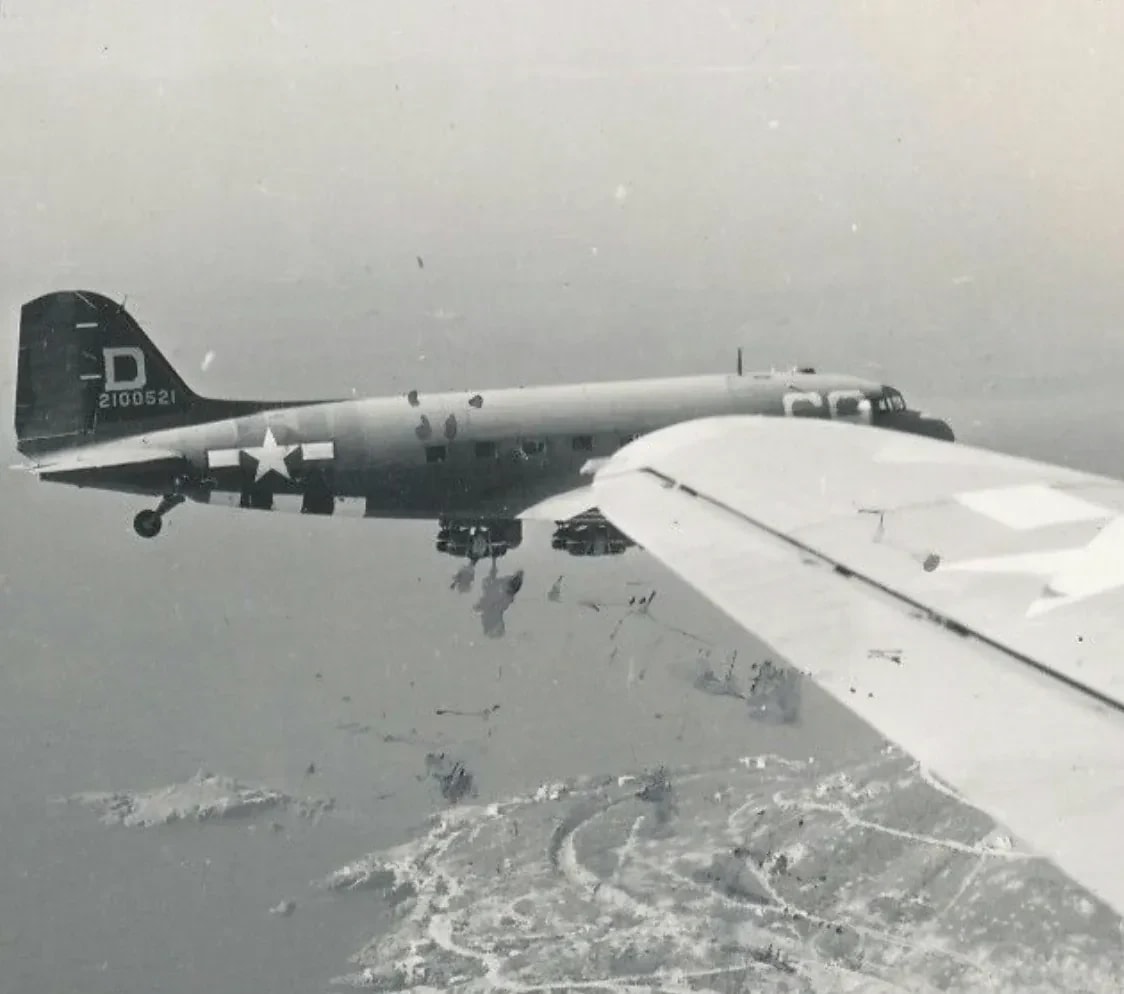 Night Fright during Operation Dragoon With the invasion of Normandy now underway, along with the ongoing offensive through Italy in the south, Allied planners turned to their pre-existing plans to invade the Mediterranean coast of France at Marseilles. Originally dubbed Operation Anvil, the invasion was now to be launched as Operation Dragoon, and it was decided that the 436th TCG would send a detachment of 48 C-47s (12 from each of the group’s four squadrons) to Allied-held Italy to participate in this new offensive. Among the 12 aircraft of the 79th Troop Carrier Squadron to be sent to Italy would be Night Fright, with the aircraft being flown from Membury to Marrakesh, then to Voltone Airfield, about 46 miles northwest of Rome, with an extra aircraft being flown to Voltone to make 49 C-47s from the 436th TCG. On August 15, 1944, Operation Dragoon got underway. The detachment from the 436th was to transport CG-4A gliders carrying members of the British 64th Airlanding Light Battery, a light artillery battalion who were to provide artillery support for the British 2nd Battalion, Parachute Regiment (2 PARA), with this sortie being codenamed Mission Bluebird. The 436th TCG flew the 64th to Landing Zone (LZ) ‘O’, located just east of the commune of La Motte, in the French region of Provence. However, heavy fog over the LZ forced the C-47s and the gliders to circle over the French Riviera coast for an hour, waiting for new orders. But before Mission Bluebird was to be aborted, the fog over the LZ cleared, and the gliders were safely released over the objective at 0930 hours. On returning to Voltone, the detachment from the 436th embarked on Mission Dove, a follow-up mission where the unit towed more gliders to LZ-A and LZ-O, with many of the gliders landing into vineyards or trees due to overcrowding over the LZs. On August 24, Night Fright and the other C-47s from the 436th TCG’s detachment were flown back to Membury, with the flight going west to Gibraltar before heading north. On returning to Membury, the detachment crews proudly showed off their newly-acquired tans, with the group’s diarist writing that it made the crews who remained in England “look like sick call” in comparison.  Co-pilot James Hardt with Night Fright The next major airborne operation Night Fright would partake in would be Operation Market Garden, which was to capture strategic bridgeheads over the Lower Rhine River in the Netherlands, which were still under German occupation, and to divert German forces from France. On September 17, 1944, Lt. Col. Adriel Williams, commander of the 436th Troop Carrier Group, held the group’s first briefing for Market Garden at RAF Membury to go over the planned routes to carry paratroopers and gliders into the mission areas. The 436th TCG were to drop 390 members of the 101st Airborne’s 506th Parachute Infantry Regiment with their aircraft organized into Serials A-12 and A-14. They were to drop their paratroopers at DZ ‘B’ north of the Dutch town of Son, near Eindhoven, where the paratroopers were then tasked to seize the bridge over the Wilhelmina Canal. At 1030 hours, Night Fright took off from Membury into murky weather, with the aerial armada flying through rain and mist on the way to the rendezvous point over Hatfield, Hertfordshire before proceeding to waypoint ‘Attu’ over RAF Bradwell Bay, and waypoint ‘Borneo’ over North Foreland, near RAF Margate. They made landfall over Ostend, Belgium and met up with the escort fighters to fly towards more waypoints over Ghent and Geel before heading for the drop zones as Dutch civilians waved from the ground at the passing aerial fleet. As the aircraft of the 436th approached the drop zones, they encountered heavy ground fire from German positions. In the 79th TCS, Night Fright’s sister ship, 42-100522 ‘SE-E’, flown by Robert Stoddart, was hit and the left wing caught fire just as the paratroopers were hooking their static lines. 42-100522 then crashed into a wooded area near LZ-W with no survivors, and another aircraft from the 79th, C-47A 42-100527, ‘S6-J” “Cherokee Strip” was forced to crash land as a result of combat damage, but fortunately, pilot Ross Hanna brought Cherokee Strip to a forcing landing near the DZ with no casualties. Night Fright was among the lucky aircraft to return to Membury. The next day, September 18, would see the aircraft be flown on another glider-towing mission, this time towing gliders carrying men from the 2nd Battalion of the 327th Glider Infantry Regiment and the 326th Airborne Engineers Battalion along with Medics of the 101st Airborne, releasing their gliders near LZ-W, north of Eindhoven. Despite having been scheduled to takeoff at 0730 hours, foggy weather over both sides of the Channel kept the aircraft at Membury until 1130 hours, but once in the air, the aircraft were sent from the South route to the North route which proved fortunate as it helped the reinforcements parry a German counterattack on the DZs and LZs between Best and Son. Despite the efforts of the combined Allied offensive that made up Market Garden, German counterattacks ensured they would maintain control over the crucial bridge at Arnhem, and despite failing to take back the Allied gains, they had prevented the planned Allied offensive into northern Germany through the Netherlands. Nevertheless, the destruction of rail and road infrastructure would require transport aircraft to fly round the clock to deliver supplies across the English Channel into continental Europe. As such, Night Fright flew more resupply missions into the Netherlands and France, delivering fuel and ammo to the soldiers fighting across the Channel and medevacing wounded soldiers to England, as well as flying prisoners of war (POWs) for them to be sent to POW camps away from the frontlines. However, many of these missions were delayed or cancelled due to rain or bad weather, with the cancellation of the Thanksgiving flights giving the crews the consolation of eating in the mess at Membury rather than spend the holiday eating K-rations on one of the Advanced Landing Ground fields in France. As November turned to December, the aircraft were being run hard. On December 9, 1944, Night Fright was to fly to Prosnes Airfield (Advanced Landing Ground (ALG) A-79) to deliver a shipment of diesel fuel when an engine failure forced the crew back to Membury. On closer inspection, the mechanics found that the aircraft required both engines to be changed, which was accomplished by December 13. It would not be a moment too soon, as Night Fright’s work load would soon increase drastically for the winter of 1944-1945. 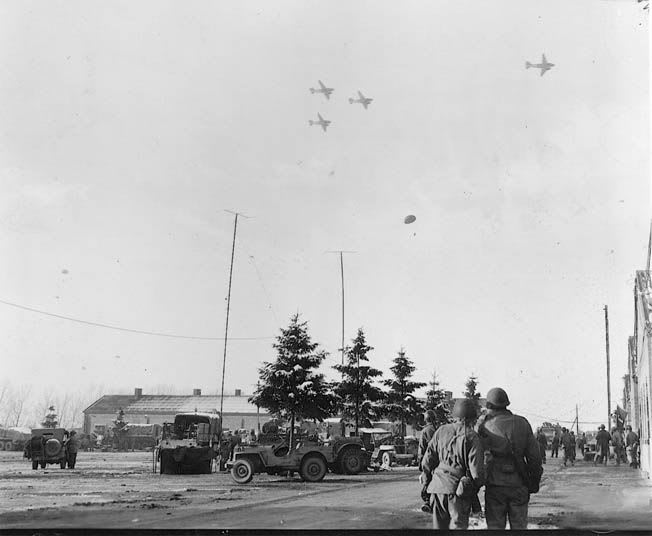 The 101st in Bastogne; C-47s supply from above  Not all were so lucky.  Men of the 101st picking up air dropped supplies With the Allies approaching their borders from France, Belgium, and the Netherlands in the west, up the Italian Peninsula in the south, with the Soviets driving through Poland on their way to East Prussia, Adolf Hitler and his generals were desperate to make one final decisive victory to blunt the Allied advance, especially since the British and Americans had liberated the port city of Antwerp in November 1944, allowing the port infrastructure to be used to advance the Allies logistical campaign. But with winter snow threatening to ground Allied aircraft, the Germans planned an offensive to drive from the Rhineland to recapture Antwerp as part of Operation Wacht am Rhein (Watch on the Rhine), with the German attack being launched on December 16, 1944. Despite initial success, American resistance in the Ardennes was stronger than expected, with the 101st Airborne Division maintaining control of the town of Bastogne, a vital link in the road network heading for Antwerp. Realizing the strategic importance of maintaining Bastogne, American infantry and armored units raced to the relief of the Screaming Eagles. With weather conditions for flying improving, the 436th Troop Carrier Group took part in Operation Repulse, the effort to resupply the 101st Airborne by air, launching resupply missions on December 23, 25, 26, and 27, taking fire from German anti-aircraft guns as they dropped parapacks to the besieged paratroopers who had become known as “The Battered Bastards of Bastogne”. During the final resupply mission, bad weather over Membury forced the group to land their aircraft at Dreux/Vernouillet Airport (ALG A-41), where the 436th TCG’s aircraft sat alongside those of the 441st Troop Carrier Group for a few days before the weather over England cleared again.  Departing Melun, France for the Rhine As 1944 turned to 1945, the 436th continued their resupply missions across the English Channel, medevac missions to bring wounded soldiers to hospitals in England, and training missions for future offensives. On February 14, 1945, the 436th Troop Carrier Group was transferred from RAF Membury to Melun Villaroche Aerodrome (ALG A-55), about 25 miles southwest of Paris. It would be from this new base of operations that Night Fright would participate in the last major airborne offensive in the European Theater of Operations, as well as the largest airborne assault to be held in a single day. On March 24, 1945, the 436th TCG took part in Operation Varsity: the airborne crossing of the Rhine River into western Germany. Their mission was to tow two Waco CG-4A gliders for each C-47, with the gliders carrying members of the 17th Airborne Division in Serials A-10 and A-11 to LZ ‘S’ near Wesel. Night Fright was made Chalk No.51, with Bill Watson as captain of the flight, and was towing two CG-4A gliders, CG-4A 45-6155 Chalk No.101, flown by pilot Warner D. Ferguson and copilot Donald J. Tracy, and CG-4A 43-43304 Chalk No.102, flown by pilot David E. Haggard and copilot Joseph J. Rice. Alongside Night Fright were C-47A 42-100519 “Captain and the Kids”, flown by Captain Ross P. Hanna, and C-47A 42-100529 with Major Hollis B. Tara as pilot, all towing gliders as well. German anti-aircraft fire was once again severe, but the crews of the 436th TCG kept steady before releasing their gliders and maintaining formation as they made their turn back for home. Just as the C-47s released their gliders, Hanna’s aircraft, 42-100529 was hit by flak and the crew was forced to bail out, but smoke and haze prevented the rest of the group to see where the plane had crashed and only that three parachutes were visible before descending into the haze. It would not be until May 1945 that one of the men aboard 42-100529, Robert Benton, had been killed, while the rest of the crew, though listed as missing-in-action, were in fact captured by the Germans and repatriated at war’s end. Overall, though, Operation Varsity was a success, and the final Allied airborne assault of the European Theater of Operations helped the western Allies secure their foothold in Germany on the drive east for Berlin. During April 1945, one of the squadrons in the 436th TCG set a record of 2,175,555lbs of freight delivered to the front, with the group being used to carry fuel for General George S. Patton’s hard-charging tank offensive deeper into Germany. The 436th TCG also continued medevacing combat wounded to hospitals, but was now also flying newly-freed Allied POWs back to Allied territory, and transported the staff and equipment of the 40th Field Hospital from Limburg Airfield (Y-83) in Hesse to a new position closer to the frontlines in central Germany. On May 8, 1945, the unconditional surrender of Germany marked the long-sought-after and hard-fought victory in Europe, but although the men of the 79th Troop Carrier Squadron celebrated, their work was far from over. In May 1945, the squadron evacuated 7,826 POWs and wounded soldiers, but only 385 evacuations would be flown in June. During this time, the 436th Troop Carrier Group was told they would begin flying back to the United States in early July, with special ‘Bolero’ fuel tanks fitted inside the C-47s to extend their ferry range. While the 436th TCG was still stationed at Melun Villaroche, they were treated to the sight of dozens of captured German aircraft, including Messerschmitt Me 262 jet fighters, landing at the airfield on their way from Lechfeld, Bavaria, to Cherbourg, where they were to transported by ship to the United States for flight testing and evaluation. Leader of the pilots and ground crews flying these German aircraft was test pilot Colonel Harold Watson (no relation to Bill Watson), whose team of American and German pilots and engineers was known as ‘Watson’s Whizzers’.  Captain Frank Bibas with Night Fright On July 10, 1945, the 79th TCS set off from England to head back along the South Atlantic ferry route through North Africa, Brazil, and the Caribbean, this time from east to west. On July 19, the squadron’s C-47s landed at Hunter Army Airfield near Savannah, Georgia. The men were given 30 days leave, then tasked with flying their aircraft to Baer Field, Indiana, the 436th’s predeployment assignment, but would later transfer to Malden Army Airfield in Malden, Missouri, while senior officers were tasked with bringing new officers up to speed before they were to be discharged. Meanwhile, C-47A 42-100521 Night Fright was sent to Romulus Field (now Detroit Metropolitan Airport) near Detroit, Michigan for maintenance at the end of July 1945 before returning to the 436th. With the Japanese surrender on August 15, the 436th TCG was later inactivated on November 15, 1945, with the unit's assets, including Night Fright, having been absorbed into the 434th Troop Carrier Group by October 1945. But like many of the wartime units, thousands upon thousands of airplanes, tanks, and ships in the US military were now no longer necessary in a peacetime setting. Those that would not remain in active service or be placed in reserve would be put up for disposal or sale to the private market through the U.S. government’s Reconstruction Finance Corporation (RFC), which set up disposal sites across the United States to sell or scrap surplus airplanes. As such, C-47A 42-100521 was flown on October 30, 1945, to Walnut Ridge, Arkansas, where the former Walnut Ridge Army Airfield/Marine Corps Air Facility Walnut Ridge was being used to scrap or sell thousands of fighters, bombers, transports, and trainers. Some of these planes had seen extensive service in combat overseas or used as transports and trainers at home. Others were fresh off the factory floor, but were suddenly no longer needed. In total, more than 10,000 airplanes were spread out across Walnut Ridge Airport. While much of the fighters and bombers sent to Walnut Ridge and other disposal sites were cut up and melted down into aluminum ingots to be converted into everything from automobiles and refrigerators to cooking pots and pans, many of the C-47 Skytrains would find new life as DC-3 airliners.  Night Fright as the Tidewater Pacemaker with Piedmont Airlines; President Tom Davis stands to the right In 1946, 42-100521’s fortunes changed: now issued the civilian registration NC65384, she was sold by the RFC to Executive Transport Corp., a Texas-based company that tried but failed to sell the aircraft to Penn Central Airlines, but on June 5, 1947, Executive Transport sold NC65384 to Northeast Airlines, which operated routes primarily to cities in New England and the Mid Atlantic, such as flights from Boston to New York. Less than a year later, though, NC65384 was sold to Piedmont Airlines on April 26, 1948. Based in Winston-Salem, North Carolina, the then-brand new Piedmont Airlines had a naming convention where their planes were given names that ended with ‘Pacemaker’. When NC65384 (later N65384) joined Piedmont, it was christened ‘Tidewater Pacemaker’. Though most of Tidewater Pacemaker’s flights were largely uneventful, N65384 suffered a mishap in gusty conditions in Greensboro, North Carolina while operating as Piedmont Airlines Flight 20 on October 20, 1952. By March 1953, Tidewater Pacemaker was back in business, and when Piedmont changed the registrations for their fleet of aircraft, N65384 was re-registered as N45V. While operating for Piedmont as N45V, Tidewater Pacemaker was the aerial scene of a strange case. On June 13, 1955, while operating as Flight 5 from Fayetteville, North Carolina to Louisville, Kentucky with intermediate stops at Charlotte and Asheville, North Carolina, and Tri-Cities Airport, Tennessee, a man named Oran Pruitt fell 6,000 feet to his death from N45V over Shelby, North Carolina after the cabin door opened in flight, his body landing in a church graveyard. The opening of the cabin door caused N45V to yaw to the left, but after the initial shock, First Officer Henry A. Schulze, Jr. and Purser Bert R. Barnes helped get a woman who had been in the lavatory when the door opened to get past the open doorway, and after circling to mark the location of the incident, Captain Baxter B. Slaughter, Jr. brought the plane to land at Asheville, where the rest of the flight was cancelled and the aircraft kept grounded during the subsequent investigation. When Pruitt’s body was examined, he was found to have been intoxicated, and investigators came to believe that he had accidentally opened the door in fact, but any larger motives remain the suggestion of speculation. After the investigation concluded, the minor damage done to the airstair door of N45V was repaired, and the Tidewater Pacemaker returned to service, remaining with Piedmont Airlines until being sold to Charlotte Aircraft Inc. on February 28, 1962 as Piedmont began gradually transitioning from the DC-3 to new aircraft like the Fairchild F-27 and the Martin 4-0-4 airliners.  The Tidewater Pacemaker - named for the Tidewater region of Virginia - boarding passengers in Winston-Salem, NC.  Smith Reynolds Airport, Winston-Salem, NC, home of Piedmont  The Duke University Men's Basketball team headed to the NCAA tournament, Raleigh-Durham Airport, 1960  A familiar name still graces her port side wing  Night Fright back in uniform On March 5, 1963, N45V, the former Night Fright/Tidewater Pacemaker was once again in military uniform, this time for the French Navy’s Aéronavale as serial number 18954. With the Aéronavale phasing out their smaller Beechcraft JRB/C-45 Expeditors in favor of surplus C-47s/DC-3s, s/n 18954 was flown across the Atlantic to Paris Le Bourget Airport, where the company Société d'Exploitation et de Construction Aéronautique (SECA; Aeronautical Construction and Operations Company) was contracted to overhaul and convert the aircraft for use as a trainer for personnel who were to become specialists and technicians aboard French maritime patrol aircraft, as well as to serve as a logistical support aircraft. Among the modifications were new equipment in the cabin for training the maritime patrol technicians in radar units, the navigational astrodome was moved from the front section of the cabin to the aft section, and upgrading the cockpit avionics. After the new modifications were complete, s/n 18954 was assigned to Escadrille 56S, nicknamed Mérou (Grouper), at Nîmes–Garons Airport (now Nîmes-Grande Provence Méditerranée Airport), situated between Montpellier and Marseilles on the southern coast of France. The aircraft was flown with the number 84, and had the following callsigns over its nearly 20-year career: F-YGGG, F-YGIA, and F-YGGF.  As number 84 with the French Navy  Three Gooneys all in a row! During its time with the French Navy, s/n 18954 flew on navigational exercises over the Mediterranean, and on at least two occasions (June 17, 1969 and April 20, 1970), the aircraft landed at Luqa Airport, the main airport for the island nation of Malta. By 1984, the Aéronavale was phasing out its C-47s/DC-3s, and that year, s/n 18954 was decommissioned from active service before being sold to Basler Flight Services of Oshkosh, Wisconsin, with the aircraft being flown flown back across the Atlantic to the United States following the path of the wartime North Atlantic Ferry Route, flying from France through the United Kingdom, Iceland, Greenland, and Canada to the United States.  In Reykjavik, Iceland, newly registered as N98BF with Basler By September 12, 1985, the former Night Fright was registered as N98BF. Within two months of being registered to Basler Flight Services, N98BF was sold to Aircraft International Charters of Conroe, Texas, who sold the aircraft to Sky Freighters Corporation of Grand Prairie, Texas, who had her registered as N308SF on November 30, 1985, and over the next four years, N308SF was flown as a freighter before being sold to Belle Meade Air, Inc of Nashville, Tennessee in December 1989, but just three years later, N308SF was sold to Dodson International Air of Oxford, Georgia in July 1992. Fifty years after Night Fright had been built for war, she was now a workhorse being chartered to fly freight all over the Caribbean, as well as North, Central, and South America, with the aircraft being especially busy flying supplies into regions affected by hurricanes, and hauling everything from chickens to generators. In October 2002, N308SF was sold to BS&J Leasing of Hopkinsville, Kentucky, which in turn was associated with Tuckasee Air Cargo, where she continued her career as a contract cargo carrier. By September 2007, the aircraft was, by coincidence, managed by C.J. Aviation Services at Greensboro, North Carolina, the same place where she had suffered her mishap while flying as Piedmont Airlines Flight 20 some 55 years earlier. Yet with N308SF being by then a 64 year old airplane, it was clear that unless she received extensive modifications, her cargo career would soon come to an end. C.J. Aviation attempted to sell N308SF on eBay. First, the sales price stood at $150,000 before being lowered to $88,000, but the highest bid received amounted to $50,100 by July 2008.  With Skyfreighters in Oklahoma, 1986  With Dodson in the 1990s  In Greensboro, North Carolina, 2007  From Fright to freight On August 30, 2008, N308SF was sold to Universal Asset Management Inc. For several DC-3 enthusiasts, this development was somewhat concerning, as Universal was known for scrapping aircraft it could not sell, but luckily, that would not be the case for N308SF, at least not yet. By the time Philip & Charlie Walker and Tom Woodhouse found N308SF at Walnut Ridge, followed with confirmation from Roger Day of its wartime history, the aircraft had 52,000 hours on the airframe, and Woodhouse and the Walkers knew they had found their airplane for the Membury Estate, and so they purchased it from Universal Assets in December 2012. But acquiring the airplane was one thing: returning it to the United Kingdom was another matter entirely. Together, Philip & Charlie Walker would get N308SF in ferryable condition to fly out of Walnut Ridge. In July 2013, they made N308SF ready for her first flight in years, and flew the aircraft from Walnut Ridge to Punta Gorda, Florida. It would be here that Night Fright would partially disassembled, with the outer wing panels and tail control surfaces being removed to allow the aircraft to be towed by road from Punta Gorda Airport to Shell Creek Airpark about 9 miles away in December 2013, where the paint stripping and initial restoration work would be carried out by Frank and Glenn Moss before the aircraft was to be shipped overseas to England and proceed further down the long road back to her wartime configuration.  A rather unconventional flight from Punta Gorda to Shell Creek 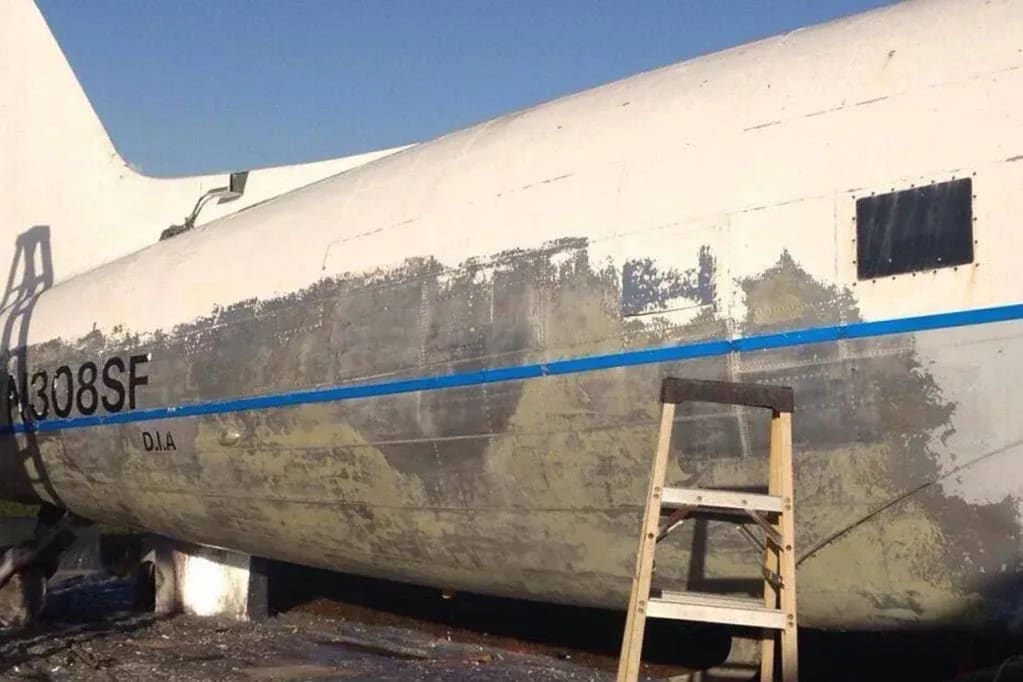 Roundel remnants  Removing port side engine From 2014 to 2016, work was carried out under the Florida sun, and in the light of the sun, Night Fright slowly unveiled some of her secrets. Although thee interior bulkheads had long since been removed, likely as result of the modifications received for the aircraft’s service with the French Aéronavale, Night Fright still retained after all these years her original formation-flying lights and the many metal patches covering the scars of bullets and shrapnel inflicted upon the aircraft during WWII. As the days turned to weeks, then months, then years, the aircraft made steady progress, with the engines getting overhauled, nonoriginal parts of the interior were removed, and the astrodome was moved back to the front section of the fuselage. By 2016, the aircraft, though still incomplete, was ready to be shipped to England. Clive Edwards and Gordon Gray oversaw the preparations to disassemble more of the aircraft, as the center wing section had to be removed from the fuselage for each section to fit in shipping containers. Through March 2017, the aircraft was carefully disassembled, its fuselage, wings, tail section, engines and landing gear all packed up into shipping containers that were then transported to a port to be loaded onto a Roll-on/roll-off (RORO) ship. It was decided that Night Fright was to be sent to Coventry Airport, where the facilities there would allow the aircraft to be fully restored, as Membury no longer had the facilities for an aircraft the size of a DC-3/C-47.  Our smiling Dak heads off on a cruise; Night Fright happy to be crossing the Atlantic once more, without doing all the work! By April 2017, the containers carrying the pieces of Night Fright had safely arrived in England, and soon they were trucked to Coventry Airport, where a restoration team led by Ben Cox would continue where the work at Shell Creek had left off. At Coventry, the Night Fright crew restored everything original that could be reused, and for those parts that were missing or too far good to be used as part of an airworthy aircraft, were replaced with both new-old parts from other C-47s/DC-3s or were fabricated by the team for their needs. 2018 would proud a pivotal year for the project, as the major sections were coated in primer, the tail section was refitted to the remainder of the fuselage, the center wing box was reattached to the fuselage, and the aircraft was standing on its landing gear with its engines in their mounts. At the time, the team was hoping to have Night Fright ready to fly in time for the 75th anniversary of the D-Day landings, where a worldwide gathering of DC-3s and C-47s would soar once more over the skies of Normandy. Around a dozen engineers from Heritage Air Services world up to 500 to 600 hours a month on Night Fright’s structure, cargo floor, avionics, fuel, oil, and hydraulic systems, and having three R-1830 engines overhauled in the United States by Anderson Aeromotive in Idaho and Global Radial Engines in Oklahoma. Media attention also came to the Night Fright Restoration Team when Channel 4 presenter Guy Martin featured Night Fright in the 2019 documentary Guy Martin’s D-Day Landing. Despite the best efforts of all involved in the rebirth of Night Fright, the team was still far behind getting the venerable back in the air in time for the 75th anniversary of D-Day, and C-47A 42-100521 remained under restoration at Coventry. Nevertheless, the team carried on, and focused on fitting Night Fright out with the most historically accurate WWII equipment to be flown on an airworthy C-47. Though there were many who were involved in donating or tracking down equipment, Neil Jones, an RAF sergeant and project volunteer, was among the most influential members of the restoration team in terms of tracking down authentic navigation radio equipment to make Night Fright look like it just flew into the present day from 1944. At the start of 2020, the Night Fright Restoration Team made contact with the 436th Operations Group, the modern iteration of the 436th Troop Carrier Group, based at Dover Air Force Base, Delaware, with the unit throwing their support being the efforts of the team at Coventry. Unfortunately, when the UK went through a national lockdown period during the COVID-19 pandemic, work on Night Fright came to a halt from March to October 2020. With the lockdown policies relaxed, though, the Night Fright restoration team focused on the structure of the aircraft, sub-systems and detailing. Among the parts completed were a new rear bulkhead, the fitting of the undercarriage jacks, repairs for the fuel tanks, the completion of the crew seats, installation of the repaired wing root fairings, a new tail cone, finishing work on the engine cowls, painting the repaired horizontal stabilizer, and more. Another decision made regarding the restoration was whether or not to retain the original wings for Night Fright or replace them with another set at Coventry Airport. In the end, it was decided to use the original wing panels, with the team seeding three weeks removing the skins of the undersides of the wings, cleaning and paint stripping the wings, assess the structural condition, perform necessary repairs, and by June 2021, the work of repairing the wings and reinstalling the skins was complete. As work progressed on the C-47 Night Fright at Coventry, the future of the airport itself was uncertain. By 2021, both the Coventry City Council and The Rigby Group proposed closing the airport to build a gigafactory for electric car batteries, with planning permission being granted in 2022. Yet the work on Night Fright continued, with the cockpit and cabin being outfitted to as close to its 1944 configuration as possible, engine and flight control systems were installed, and more panels were being worked on. All the while, the restoration team also acquired the cockpit section of C-47A 42-24238, which flew in combat for the RAF during WWII as a Dakota Mk.III with the RAF serial number FL517. After the war, the aircraft flew for Scottish Aviation as G-AJAZ, then for the Spanish airline Iberia as EC-ADR before being transferred to the Spanish Air Force as serial number T3-61 before being sold for surplus, broken up in Dusseldorf, and the cockpit section was purchased in 2006 by collector Rich Simms, who outfitted the cockpit with original instruments before the section was sold to the restoration team. 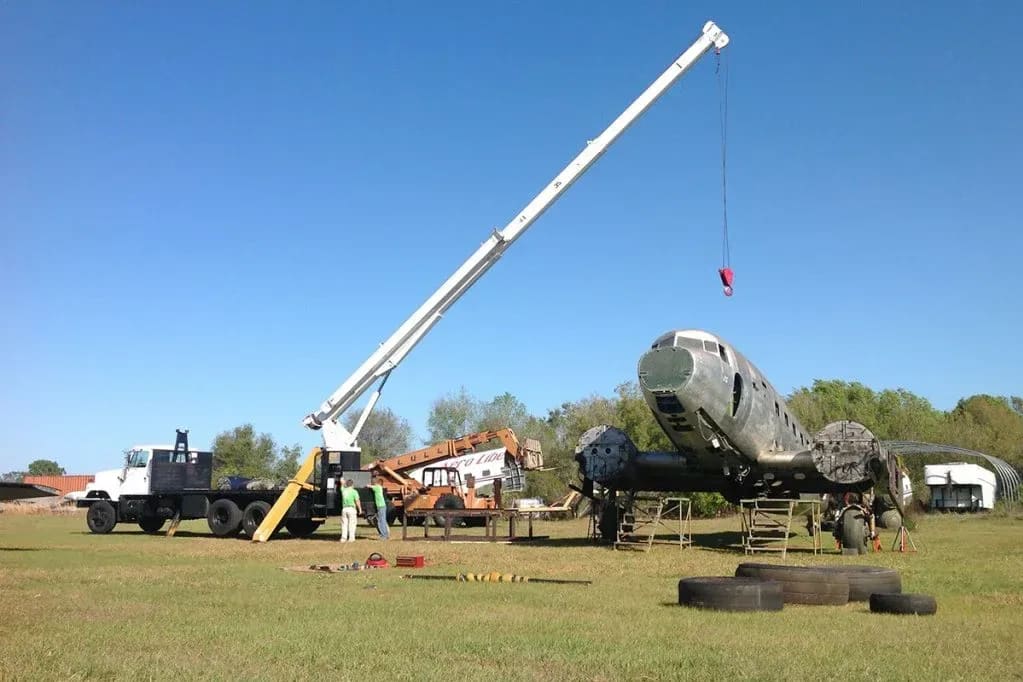 Safely home at Coventry 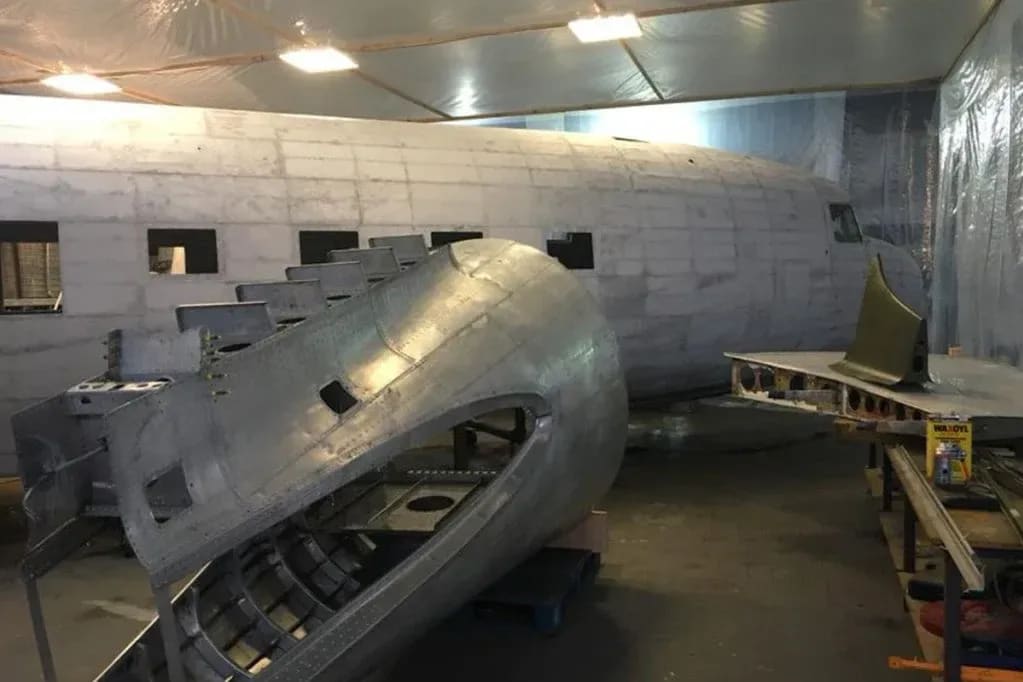 Fuselage and tail section  Overhauled Twin Wasps ready to go  Corrosion repair  Slowly reverting to her natural state  Night Fright undergoing her glow up - in more than a few ways  On the ground at Sywell after her "second" maiden flight By 2024, Night Fright’s wings and tail surfaces had been outfitted, its fuselage and wings had been painted, and in one of the most exciting developments of the restoration, the two Pratt & Whitney R-1830 Twin Wasp radial engines on Night Fright roared to life. Yet even as the finish line for the first flight became increasingly more tangible, the end of Coventry Airport, originally established in 1936 as Baginton Aerodrome, was also approaching. By December 2025, the Civil Aviation Authority (CAA) confirmed that Coventry Airport was to be closed by June 11, 2026. Now it was a race against time to get Night Fright ready for her impromptu first flight, to the point that the aircraft’s engine cowlings and aft cabin door were still coated in primer. Finally, on the evening of June 9, 2026, with Coventry Airport set to close in two days, Ben Cox and Charlie Walker pushed the throttles forward, and for the first time in 13 years, Night Fright was back in the air. After 15 minutes of checking the flight controls, N308SF landed back at Coventry before setting off for Sywell Aerodrome in Northamptonshire that same day. 32 minutes after taking off from Coventry, Cox and Walker landed at Sywell, and today Night Fright remains there, still operating under her American registration N308SF.  Night Fright at rest in her new home. Although Night Fright has now flown again, and will continue to fly, there is still more work to be done, namely at the former RAF Membury. Though a small runway remains for ultralights and paragliders, the large runways that once saw thousands of C-47s and Dakotas embark on dangerous missions during one of the most pivotal conflicts in modern history have been reclaimed for peacetime purposes in agriculture and industry. But with Night Fright having flown from RAF Membury from 1944 to 1945, the goal now is to restore the runways at Membury Estate to the length and width necessary to comfortably accommodate a Douglas C-47. Additionally, Charlie Walker has plans to build a museum at Membury, not only to tell the story of Night Fright, but of the men who flew and maintained aircraft at Membury during the war, from pilots and airborne troops to ground crews ranging from mechanics to weather forecasters, air traffic controllers, intelligence officers, kitchen staff, medical staff, and more unsung men, as well as the stories of locals who saw a bustling airfield emerge from the fields, only to fade away within a few years. Despite having a life that spans 83 years at this point, the C-47A Skytrain now known the world over as Night Fright has not reached the end of its story, but rather, the page has turned to a new chapter in the aircraft’s long life. From dropping paratroopers and towing gliders from Normandy to the Rhine, to flying passengers across the Southeastern United States, flying training missions for the French Navy or hauling cargo and freight throughout the Americas, Night Fright has already lived many lives, and now with a dedicated team of restorers, pilots, and mechanics, plus support from enthusiasts from around the world, this old workhorse enjoys the support from a new band custodians who intend maintain her for the next generation as Night Fright begins a new phase in her long and storied life.  A C-47 in Her CivviesWhile we have little information from her time at Northeast - which was under a year - Night Fright served Piedmont Airlines' Route of the Pacemakers for well-nigh fourteen years; with the exception of a belly landing in Greensboro, NC, she had a quiet career. Well, mostly quiet...  A Fright, Alright!By Chris Runge Curator, Piedmont Aviation Historical Society 70 years ago, June 13, 1956, Piedmont suffered its first passenger fatality in a way that still boggles the mind. It happened on a DC-3 known as the "Tidewater Pacemaker." N45V came to Piedmont from Northeast as N65384. But before it entered commercial service, it was a key aircraft in World War II. Built for the USAAF and introduced as a C-47 in 1943, it was allocated to the European Theatre. In preparation for D-Day, the plane was given the code S6 and nose art "Night Fright" was applied. The plane has been painstakingly refurbished and is once again flying thanks to some dedicated aviation heroes overseas. They have assembled an amazing website chronicling the history of this incredible plane. It is well documented and contains some wonderful photographs. They also even reached out to the Piedmont Aviation Historical Society for research and photos. But first, the most mysterious bit of history connected to this plane happened in the skies over Shelby, NC. Oran Asa Pruitt (also spelled Oren Ase in some documented accounts) met his future wife, Blandene Smith at the hotel where they both worked. He was a chef, and she was a hostess. They quickly married and planned their honeymoon. On June 13, 1956, they arrived at Charlotte's Airport too late for the flight they had booked. They were promptly put on Piedmont's Flight #5 to Asheville. The Pruitts got the last 2 seats on the DC-3 and at 5:44pm, the fully loaded flight took off for AVL. The crew consisted of Captain Baxter Slaughter, First Officer H.A. Schulze and Purser Bert Barnes. Everything was normal until they reached the cruising altitude of 6,500 feet. Mr. Pruitt glanced at his wife and thought she looked "a little peaked." He offered to get her some water and headed to the lavatory in the back of the plane. Finding the lav in use, Mr. Pruitt, for whatever reason, opened the only other door in the rear of the plane which happened to be the cabin door. Incredibly, when he opened the door, only passengers near the exit knew it. The DC-3 was not pressurized so there was little in-cabin disruption. Still, Purser Barnes knew it, and he rushed to the cockpit. The combination of the opening in the plane and his rush to the front caused the plane to yaw left and slow down by 20 knots. Slaughter and Schulze knew there was a problem. Schulze and Barnes immediately went to the back of the plane and discovered the open door. There was also a terrified woman who had been the person occupying the restroom. She was now standing outside the lav in front of the open door. Barnes and Schulze locked hands and formed a human chain to assist her past the opening and back to her seat. Pruitt was nowhere to be found. The flight continued to Asheville where they landed with the door still open. Law enforcement from several North Carolina agencies and Piedmont employees were called in to determine what happened. According to Zeke Saunders, VP of Piedmont, heel marks were found on the side of the plane indicating Pruitt may have hung on for a while. He also concluded that a hissing sound reported by residents near the area of impact was likely Pruitt screaming. Mr. Saunders thinks he was probably alive most of the way down. Ironically, Pruitt's body landed in Zion Baptist Church Cemetery in Cleveland County. They placed a small monument in the spot where he landed, and it remains there today. This was the first death on a Piedmont flight in their 8 years and nearly 385 million miles of flying. Debates continue about why Pruitt opened the door. Some people claim the couple was seen fighting in CLT prior to their departure. Others claim he was drinking. We'll probably never know the exact reason Pruitt opened that door and fell to his death. As noted, N45V has a new/old life in England as it has been restored to original C-47 status. Much of this information came from Piedmont Airlines: A Complete History by Richard Eller, the Night Fright restoration crew, Savannah Bess, and the Piedmont Aviation Historical Society.  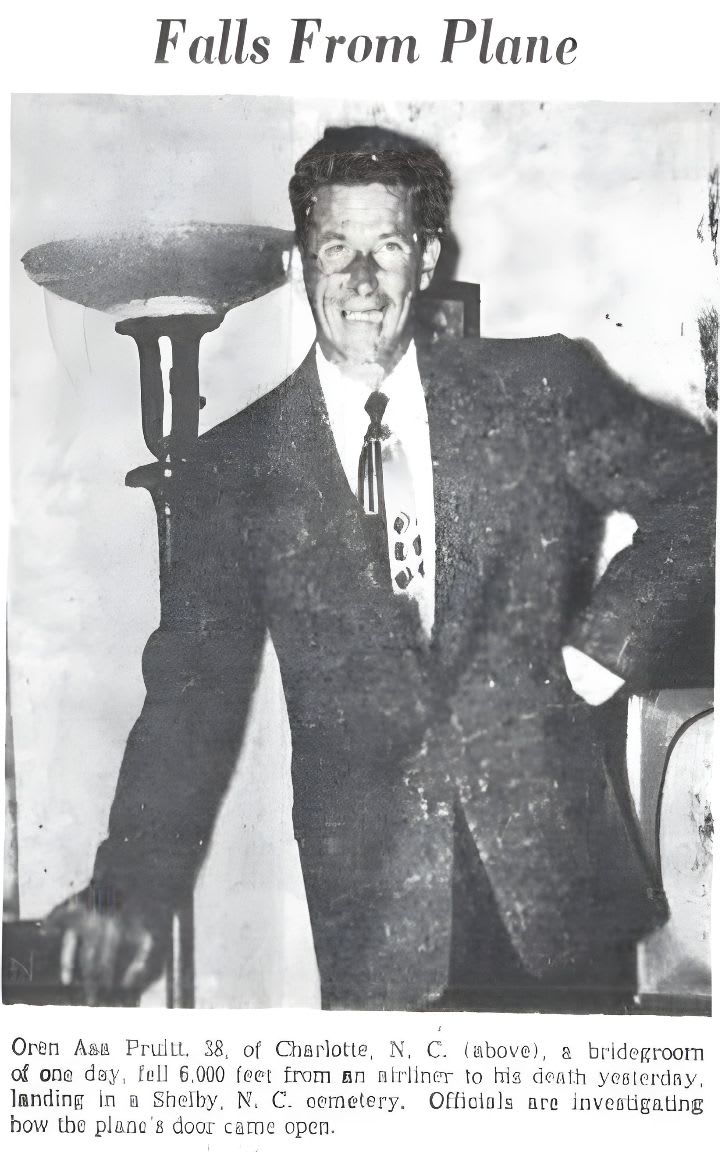  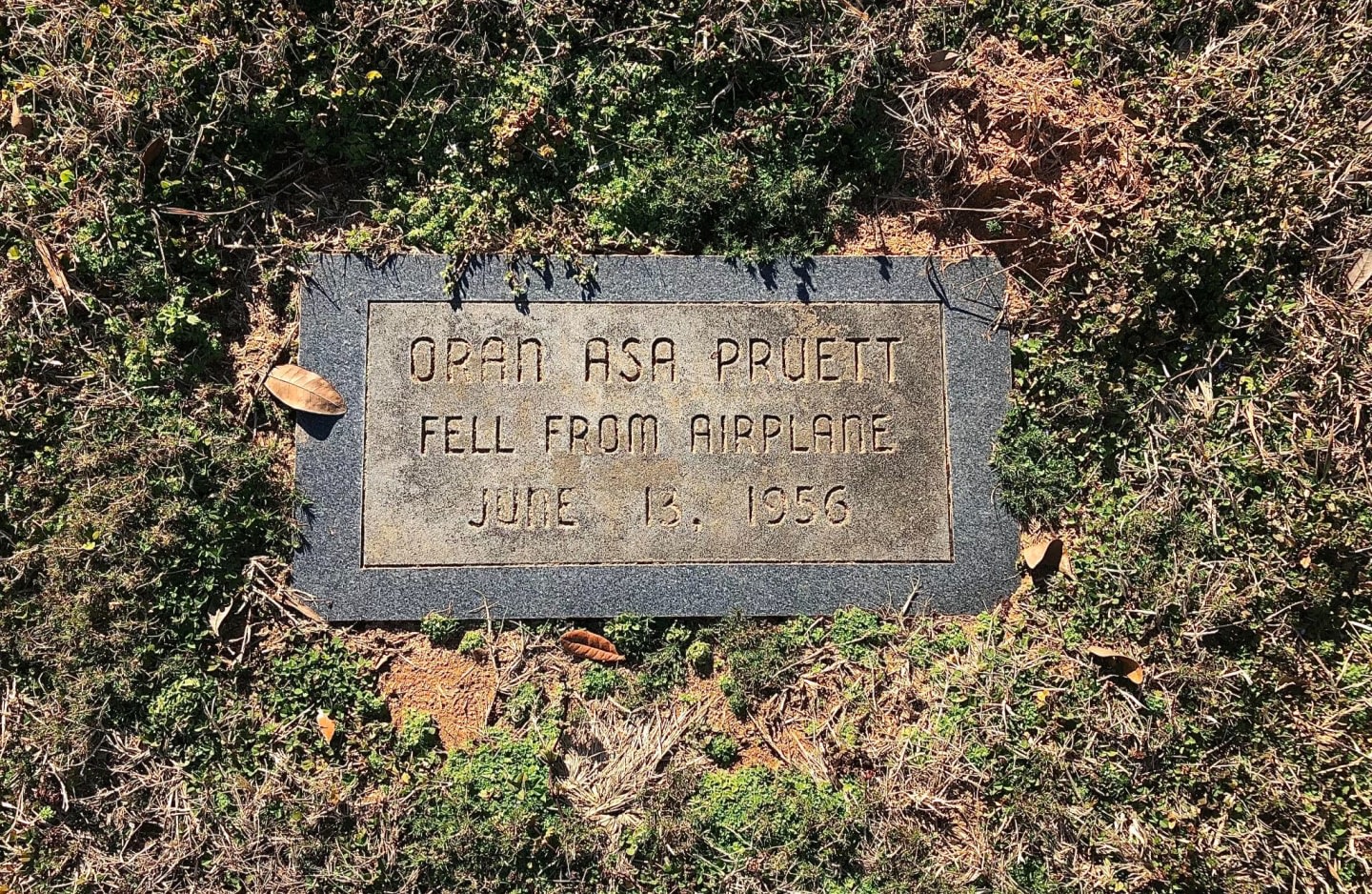 Pruitt's "landing" spot, Shelby, NC - taken by editor Family HeirloomsI had the wonderful opportunity to speak with Martha Morford, the daughter of F/O H.A. Schulze - who went on to become a respected and storied captain with Piedmont - who was operating the infamous Flight 5. Of especial interest is his flight log! - Savannah Bess Martha: "As you can tell, I grew up in an aviation family. Besides my dad, I have two brothers: one was ATC and the other was a Navy pilot and airline pilot. Since my brothers are older than I am by 10+ years, I actually had to reach out to them. I know a lot, but they lived through the early years of Piedmont Airlines. To answer your questions: After WWII, he missed flying and tried to get on with an airline, which was hard to do with other military pilots doing the same. Someone told him about Piedmont and here we are. I think he was #80 to be hired by the airline. That was in 1953 and he was with them till the late 70's. He started on the DC-3 and ended with the 737s. As for the day Pruitt fell out, dad was first officer in the cockpit. Didn't have much contact with the passengers. He did mention that the purser smelled alcohol on Pruitt. Also, the handrail was bent where he was hanging on. CAB investigation: My brother remembers seeing dad on TV news at a trial for an incident. He was on the witness stand. Might still be footage somewhere. It was a local station in Winston-Salem. This flight changed Piedmont regulations for the door and put chains on them. In his log books his last flight on N45V was 7-21-61, last on the DC-3s 11-2-62, then on to the 404's. He has many entries in the log book for N49V too. I have to give most of the credit to my brothers (Bob and Bill Schulze). On a fun note: My oldest was at the University of Alabama and was taking a Folklore class. The professor brought up the story about a man who fell out of a plane and landed in a graveyard. My son spoke up and said it was a true story because one of the pilots was his grandad!" Thanks for sharing with us, Martha!          Get Your Event Published!
Do you know a company interested in becoming an Affiliate Partner to the DC-3 Society?Please share this link to have them join us, be recognized, their products and services amplified across our membership, and invited to our events:Join As An Affiliate Partner Today! Still in the Store!
Get online, gear up, and join us in honoring aviation history! Shop today: SHOP HERE    |
