Friends of Wellfleet Ponds Summer 2026
Welcome to the FWP Summer E-newsletter- “No Commercial Activity on Wellfleet's Ponds”
- Learning to Swim at Gull Pond
- Summer Swim Stories from the Ponds
- Environmentally Friendly Ways to Control Mosquitos
- When is a really great pond not a Great Pond?
- Pond Art in the “Art Gallery Town”
friends of wellfleet ponds
ANNUAL MEETINGThursday, July 16, 4pm-6pmWellfleet Preservation Hall 335 Main Street"The Status of Cape Cod Ponds"Andrew Gottlieb, Executive DirectorAssociation to Preserve Cape CodAll Are Welcome 4:00 - 5:15 pm Program Reception to follow with light snacks, wine and beer. To help us plan for the event, kindly RSVP to info@wellfleetponds.org No Commercial Activity
on Wellfleet's PondsFriends of Wellfleet Ponds believes that commercial use of the ponds is detrimental to their long-term health. Therefore, as a matter of policy, we oppose any commercial activity on the ponds. Wellfleet’s fresh water ponds are among the last pristine ponds on Cape Cod. The ponds are of incalculable value to Wellfleet and we believe the Town of Wellfleet has an obligation to protect them. Friends of Wellfleet Ponds is not alone in this position. We recognize that there is an inherent tension between preserving the ponds and enjoying the ponds. Wellfleet needs to balance preservation with managed public recreation. Private, for-profit commercial activity on the ponds tips this balance in the wrong direction. Learning to Swim at Gull PondIn 1953, the Town of Wellfleet’s Recreation Committee began offering swimming lessons at Gull Pond. Though unofficial lessons had been taking place for years – often parents taught their children to swim or, at least, to dogpaddle in Long, Gull, or other ponds - many of us who swim in the ponds today learned how to swim and dive in the classes offered here on weekday mornings. Sign at entrance to Gull Pond announces Swimming Class times. Suzanne Grout Thomas, Wellfleet’s recently retired Director of Community Services, remembers that her grandfather taught her to swim at Long Pond, but as a 10-year-old, she was terrified of diving into the water headfirst. So, her mother signed her up for diving lessons at Gull Pond. She refused to dive off the raft the first time. Then her mother told her instructor to push her in! After some hesitation, the instructor did just that. Once she surfaced, her fear disappeared, and she had no problem diving into the water from that time forward.
The official instructors were (and still are) Red Cross Water Safety Instructor certified, and parents could sign their kids up for lessons at a card table set up on the lawn outside of town hall. Though registration for these lessons now occurs online, the tradition of swim lessons at Gull Pond continues, with classes for the older children occurring earlier in the morning and classes for the youngest taking place closer to noon, when the water has warmed up a bit. Many fledgling lifeguards got their start here, learning how to swim at Gull Pond through these well-attended classes. They then went on to become “swim aides” who helped the certified instructors with headcounts and other tasks. At age 15, they could take the level 6 Red Cross certification course and test to become official lifeguards. Though the town’s ocean beaches all have lifeguards during the day, Gull Pond is the only Wellfleet pond that has lifeguards, who are present at the pond during the weekday morning lessons.
Over the almost 75 years that Wellfleet has offered swimming lessons at Gull Pond, many families can claim that several generations have learned to swim and dive in this kettle pond: grandparents, parents, grandkids, and even great-grandkids.
The appeal of kettle ponds… “Family lake culture spans the entire glaciated fringe, developing wherever small lakes are isolated from the buzz of modern life and can be accessed by road… there is a sense of outdoor intimacy rather than grandeur, security rather than adventure, enclosure rather than endless vistas, neighbors rather than gated communities, and water warm enough to swim in. The view ……. a limited stretch of blue water bounded by a forested bluff, something that can be safely crossed in a few minutes by boat.” From: Beyond Walden: The Hidden History of America’s Kettle Lakes and Ponds, Robert M. Thorson (2009), p. 141.
A family relaxes at Gull Pond in 1960. Photo courtesy of Barbara Carey. Summer Swim Stories from the PondsEven if you’ve only swum a few times in our beautiful kettle ponds, you probably have a story or two about the experience. For this summer issue of the FWP newsletter, we asked some longtime Wellfleet residents to share their stories and memories from the 1950s and 60s with us, along with a few pictures.
Susan D. remembers swimming at Dyer Pond after spending the days at the ocean beaches, riding bikes from the ocean beaches along the fire roads to the pond. There used to be a rope swing at the edge of the pond, which provided hours of amusement for adventurous kids of all ages. As a teenager, she would go to Dyer Pond for a swim before work. She always knew when it was time to get out of the pond, hop on her bike, and head for her job when she heard the bells from the clock tower at the First Congregational Church ringing out in ship's time. A ship's bell clock strikes bells in an 8-bell cycle rather than striking in hourly chimes. The bells at the First Congregational Church on Main Street still ring in ship's time to this day – the only town clock in the US that still does so. As an eight-year-old child, Suzie G. took her first swim in early spring, when the water was still very, very cold. On a surprise afternoon in early April, her father came home from work and said, “Get your suit on.” They drove in his truck to Long Pond, where her father told her, “OK, meet you on the other side!” They then swam across the pond and back. Standing on the shore shivering and wrapped in many towels, Suzie heard her father proclaim, “OK, now you’re on your own.” This meant she could bike to the pond to swim on her own for the rest of the season!  It used to be common for families to bring dogs with them to the ponds. Now, not so much, since there is more awareness of the negative impact of pet waste and activity on the kettle pond ecosystem, as well as concern about the dangerous effects of cyanobacteria blooms on dogs that swim in ponds. This 1962 Long Pond photo is courtesy of Barbara Carey. In the 1950’s, Bonnie R.’s father would drive Bonnie and her sister to Long Pond to swim on hot summer days. The teenage girls loved to swim in the kettle ponds. Some afternoons, an Army truck from Camp Wellfleet would pull up and unload a bunch of young men from the bed of the truck to swim and cool off after a hard day of training. Bonnie’s father would immediately yell, “Girls, get back in the car!” and that would be the end of their afternoon in the pond. During the 1950’s, Camp Wellfleet was an active U.S. Army anti-aircraft training base hosting up to 1,000 National Guard troops and reservists each summer. The camp was located near Marconi Beach and used the bluffs there for target practice and live-fire artillery exercises. Pond Books for Kids in the Library Friends of Wellfleet Ponds is donating educational material for a shelf in the children's section of the Wellfleet library. It will carry books about ponds and pond life! Check it out! Environmentally Friendly Ways
to Control MosquitoesAll too often, we rush to get rid of perceived pests and weeds in our yards by spraying or poisoning, so the offending pests are instantly neutralized. We do this without understanding the devastating impacts on our local ecosystems, including our beloved kettle ponds.
Pesticides, including insecticides, disrupt, damage, and contribute to the destruction of aquatic ecosystems. Airborne insecticides, such as the sprays that are used to kill adult mosquitoes, end up in our kettle ponds via air currents, wind, and runoff following rainstorms.
The larval stages of aquatic insects that live in the ponds, such as dragonflies and damselflies, are negatively affected by these insecticides, disrupting the delicate balance of the kettle pond food web, as they are both prey and predator of a variety of other organisms that live in or depend on the pond ecosystem for their sustenance. Ironically, the insecticides that we use to kill adult mosquitoes also kill dragonflies, reducing natural mosquito control, as damselflies and dragonflies are efficient and effective predators of mosquitoes. An example of natural mosquito control: a damselfly eating an adult mosquito. Here are some suggestions that we can all follow to control mosquitoes without harming our kettle pond ecosystems: - Look for and dump standing water regularly on your property (birdbaths, buckets, etc.) to control mosquito breeding at the larval stage. Anything that collects rain provides prime mosquito breeding areas.
- Use effective repellents for personal protection rather than mosquito fogging whole yards. There are EPA-approved substances that are effective against mosquitoes and ticks. These include DEET, picaridin, and oil of lemon eucalyptus (OLE), which can be found in topical (skin-applied) repellents. Clothing treated with permethrin provides the highest level of protection, as permethrin kills or repels mosquitoes and ticks upon contact.
- When you are spending time outside make sure to wear lightweight but protective clothing.
- Plant native plants to attract birds, bats, damselflies, and dragonflies, all of which are natural mosquito predators.
The delicate biodiversity of our kettle ponds is something to love, learn about, and enjoy. We can all make a positive difference in supporting these unique habitats through controlling mosquitoes in environmentally friendly ways. Guest contributor to the content of this piece: Robina Ramsay.  When is a really great pondnot a Great Pond? According to the Cape Cod Commission, Wellfleet is home to 25 ponds. Eighteen of Wellfleet’s ponds are named, seven are unnamed. In Massachusetts ponds of ten acres or more have a special legal status as “great ponds.” Such ponds are held in trust by the state for public use. Wellfleet has seven great ponds, one of which is named Great Pond, and one additional smaller, really great pond (Spectacle) with public access.
According to Massachusetts law, the public must have “reasonable access” to great ponds and the ponds must be open for fishing and boating. All of the great ponds, as well as most of the rest of the Wellfleet Ponds, are within the borders of the Cape Cod National Seashore, but three of the named Wellfleet ponds – Perch, Squires, and Hawes - do not enjoy the protection the Seashore provides, nor are they great ponds.  The 25 Wellfleet Ponds are: Herring, Higgins, Williams, Gull, Kinnicum, Spectacle, Doanes Bog, Long, Dyer, Great, Duck, Northeast, Southeast, Turtle, Grass, Squires, Hawes, Perch, and seven unnamed ponds. FWP is collecting information on each of the ponds for our website. Please contact us at Info@wellfleetponds.org, if you have stories to contribute. Pond Art in the “Art Gallery Town”For more than a hundred years, visual artists of many media – including photography, wood-cuts, oils, and water colors--have been drawn to the Wellfleet ponds. As Provincetown became a summer gathering place for artists in the early 20th century, the Wellfleet ponds provided a unique landscape for plein-air painters and others. Artists flocked to the end of the cape for both the beauty of the area and the opportunity summer art schools offered. Many artists focused their efforts on depicting Provincetown’s picturesque harbor and quaint streets, while others, perhaps more adventurous, found their way to the less developed ponds of Wellfleet. The art of the ponds they produced can be found hanging in museums around the country as well as on Wellfleet walls. The FWP is collecting a list of art depicting the Wellfleet Ponds. As we learn more, we will add to our website. If you know of an artist we should include, let us know.
A Notable Pond Painting in the
Wellfleet Public Library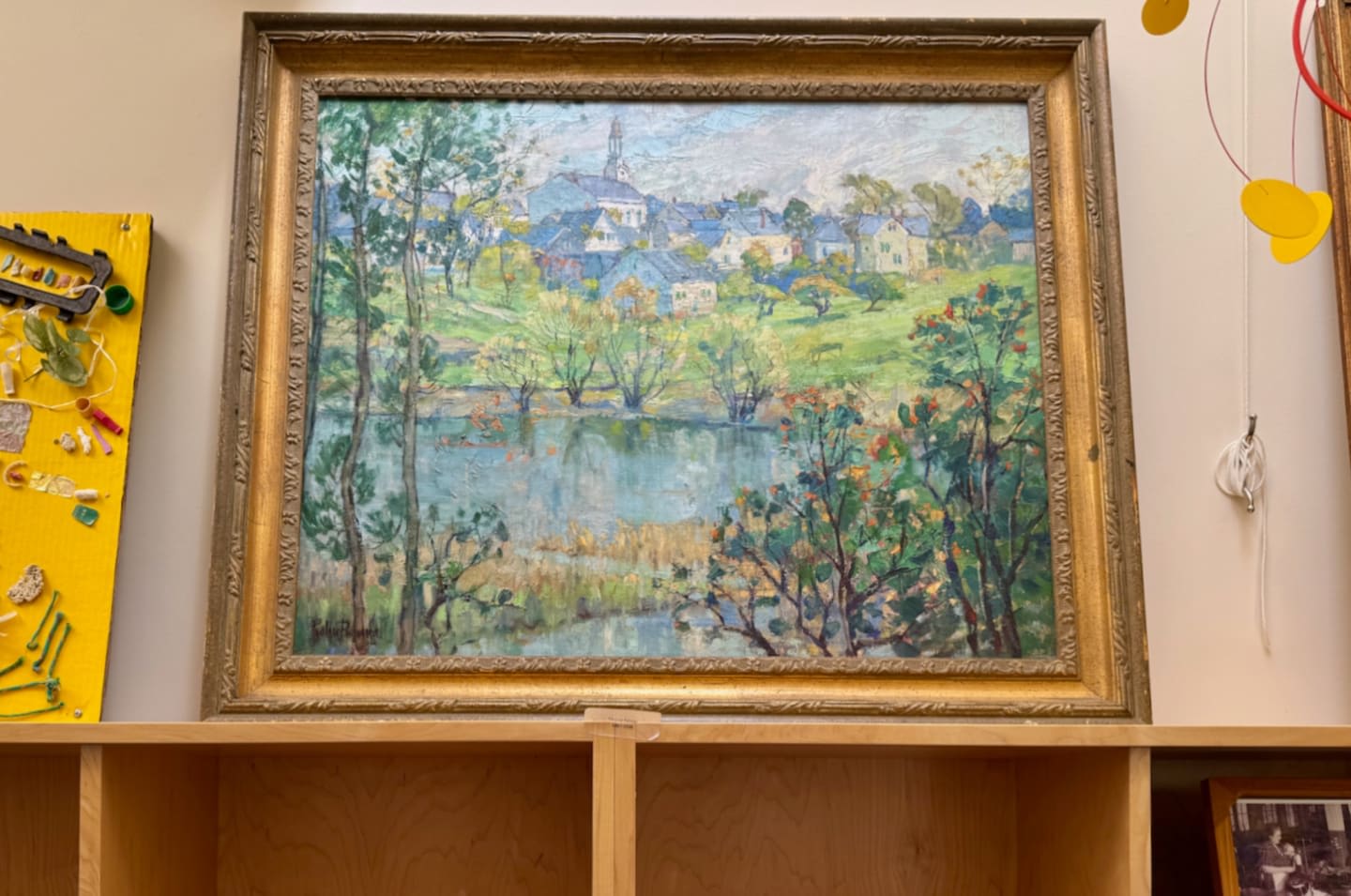 Near the back of the Wellfleet Public Library, an observant visitor can see a painting of Squire’s Pond. The painting, in the collection of Michael Parlante, is by Pauline Lennards Palmer (1867-1938), aka Mrs. Albert E. Palmer. Palmer’s view of Squires Pond is almost unrecognizable today, as the shore is now much overgrown. Squires Pond is in the center of Wellfleet, in the woods behind the Town Hall parking lot, at the end of Squires Pond Lane. Although there are clouds in the sky, above the familiar First Congregational Church steeple, Palmer has captured the sun-lit reflections on the pond in an impressionistic manner. The cluster of buildings stands at the top edge of the painting, in opposition to the bottom two-thirds which depict nature. The view is looking south, across the pond. Pauline Palmer’s work can be found in many institutional collections including those of the Art Institute of Chicago, the San Diego Galleries of Fine Arts, the Delgado Museum of Art (New Orleans), and the Union League Club of Chicago. The Provincetown Art Museum holds eight of Palmer's works, and of course there is the painting at the Wellfleet Public Library. Pond Art in “The Art Gallery Town” is an ongoing project of the FWP. Let us know if you have suggestions of artists for us to include. FWP Volunteer OpportunitiesCommunity Outreach Help distribute the Pond Lover’s Guide, which lists simple practices we can all engage in to protect pond health. Post it on bulletin boards and hand it out to friends and family.
Events & Public Engagement Represent FWP at community events. - Staff our information table at the Wellfleet Farmers Market, which is held weekly on Wednesday mornings from June through September.
- March in the FWP contingent in the Wellfleet Fourth of July parade.
- Staff our information table at community meetings, including FWP educational presentations at the Wellfleet Public Library and other community events.
- Help with the FWP Annual Meeting, which is July 16. Publicize it through posting and circulating the meeting flyer. Help setup and staff hospitality and information tables at the event.
- Staff our booth at the Wellfleet Oysterfest, October 17-18.
FWP Newsletter Help produce the FWP quarterly digital newsletter by assisting with writing, editing, photography, and layout. Online Platforms Help FWP optimize use of online platforms, including Zeffy for fundraising and donor management and Bonfire for the sale of FWP merchandise. THANK YOU for being part of the Friends of Wellfleet Ponds community — and for helping protect Wellfleet’s ponds for generations to come.
Send Questions, Suggestions and Comments to info@wellfleetponds.org With your help, we can preserve and protect our beautiful Wellfleet Ponds.
or by mail to Friends of Wellfleet Ponds | PO Box 1113 | South Wellfleet MA 02663 Friends of Wellfleet Ponds is an IRS recognized 501(c)(3) non-profit organization. Tax-deductible donations are welcome. |