 Pheo Para NavigatorNovember 2026 Research | Clinical Care | Community | ProgressWelcome to the Pheo Para Alliance's monthly newsletter. Dear Jen, This month, we're sharing important developments in PPGL research, treatment, and specialized care, along with an opportunity to raise awareness on NET Cancer Day, November 10. From new clinical trials and updated treatment guidelines to welcoming another Center of Excellence, we're encouraged by the progress. At the same time, new patient survey findings remind us how much work remains to improve awareness and access to knowledgeable care. Thank you for being part of this community and helping us move that work forward. With gratitude, Jo Dr. JoBeth McCarthy, DHSc, MPH, CPH jobeth@pheopara.org November 10 is NET Cancer Day: Help Put PPGL on the Radar! Suspect. Detect. PPGL.On November 10, we join the International Neuroendocrine Cancer Alliance (INCA) and advocates worldwide to raise awareness of neuroendocrine cancers, including pheochromocytoma and paraganglioma (PPGL). New findings from INCA's 2025 SCAN (Survey of Challenges in Access to Diagnostics and Treatment for NET Patients) Global Survey highlight the importance of awareness and access to specialized care. The survey included 3,411 respondents from 103 countries, including patients, caregivers, and healthcare professionals. Among 67 respondents affected by hereditary SDH-related pheo/para syndromes, 70% said better access to NET experts or specialized medical centers would help them manage their disease. These findings reinforce the need for greater awareness, education, and access to experienced care teams. We've created a dedicated NET Cancer Day page with downloadable resources and ideas for participating. Whether you share a social media post, start a conversation, or help someone learn about PPGL, you can make a difference. Community Updates INCA Releases 2025 SCAN Global Survey FindingsThe International Neuroendocrine Cancer Alliance (INCA) has released its 2025 SCAN Global Survey findings, highlighting ongoing challenges in diagnosis, treatment, access to specialized care, and reliable patient information. We encourage our community to explore the full report and learn more about the experiences of people living with neuroendocrine cancers worldwide.  Pheo Para Alliance at the NORD SummitI recently attended the National Organization for Rare Disorders (NORD) Summit to connect with other rare disease organizations, learn how they are using patient registries to support research, and explore best practices and opportunities for Pheo Para Alliance. The FDA also discussed its new Rare Disease Framework Initiative, which aims to address challenges in developing treatments for small patient populations—an important consideration for rare diseases like PPGL. The insights and connections from the Summit will help inform our work as we continue developing the Global Pheo Para Patient & Provider Registry and advancing our research priorities. Research CompassWhat a New Review Means for People Living with Pheochromocytoma and ParagangliomaBy Dr. Ruth Casey, University of Cambridge, and member of the Pheo Para Alliance Medical Advisory Board Earlier this autumn, Dr. Charlotte Lussey-Lepoutre of Sorbonne Université and I published a review of more than ten expert guidelines on pheochromocytoma and paraganglioma (PPGL). Here is what I think matters most for you and your family. Your genes shape your careUp to 40% of PPGLs are caused by an inherited gene change, called a pathogenic variant.1 Your result can shape your scans, surgery, and follow-up. A variant in the succinate dehydrogenase subunit B (SDHB) gene carries a 30% to 40% chance of spread. A variant in the related subunit D (SDHD) gene more often causes slow-growing head and neck tumors, with about a 5% chance of spread. Up to 80% of childhood cases are inherited, so every child diagnosed should be offered genetic testing.1 Is PPGL a cancer?Yes. The 2022 World Health Organization (WHO) classification treats every PPGL as malignant, with a variable chance of spreading.2,3 Many never spread, but no one can promise that a particular tumor won't. TreatmentIn May 2025, the US Food and Drug Administration (FDA) approved belzutifan, the first pill for PPGL that has spread or can't be removed with surgery.4 Other options include sunitinib, radionuclide therapy, and chemotherapy. The right choice depends on how fast the disease is growing, your genetics, and your overall health. It is best made with a multidisciplinary team experienced in PPGL, such as a PPA Center of Excellence (pheopara.org/education/centersofexcellence). If your tumor makes hormones, guidelines call for alpha-blocker medication before procedures to prevent dangerous blood pressure spikes. Follow-up can last decadesPPGL can return many years later. In one study of people without a known inherited variant, 18% of recurrences appeared 15 or more years after diagnosis.5 Guidelines recommend: • Hereditary PPGL: usually lifelong • No inherited cause: at least 10 years, or lifelong if you were diagnosed young or your tumor was 5 cm or larger, outside the adrenal gland, or made mostly noradrenaline or dopamine • Head and neck tumor, no inherited cause: at least 15 years Looking aheadNew blood tests and computer models may soon help predict which tumors will spread. 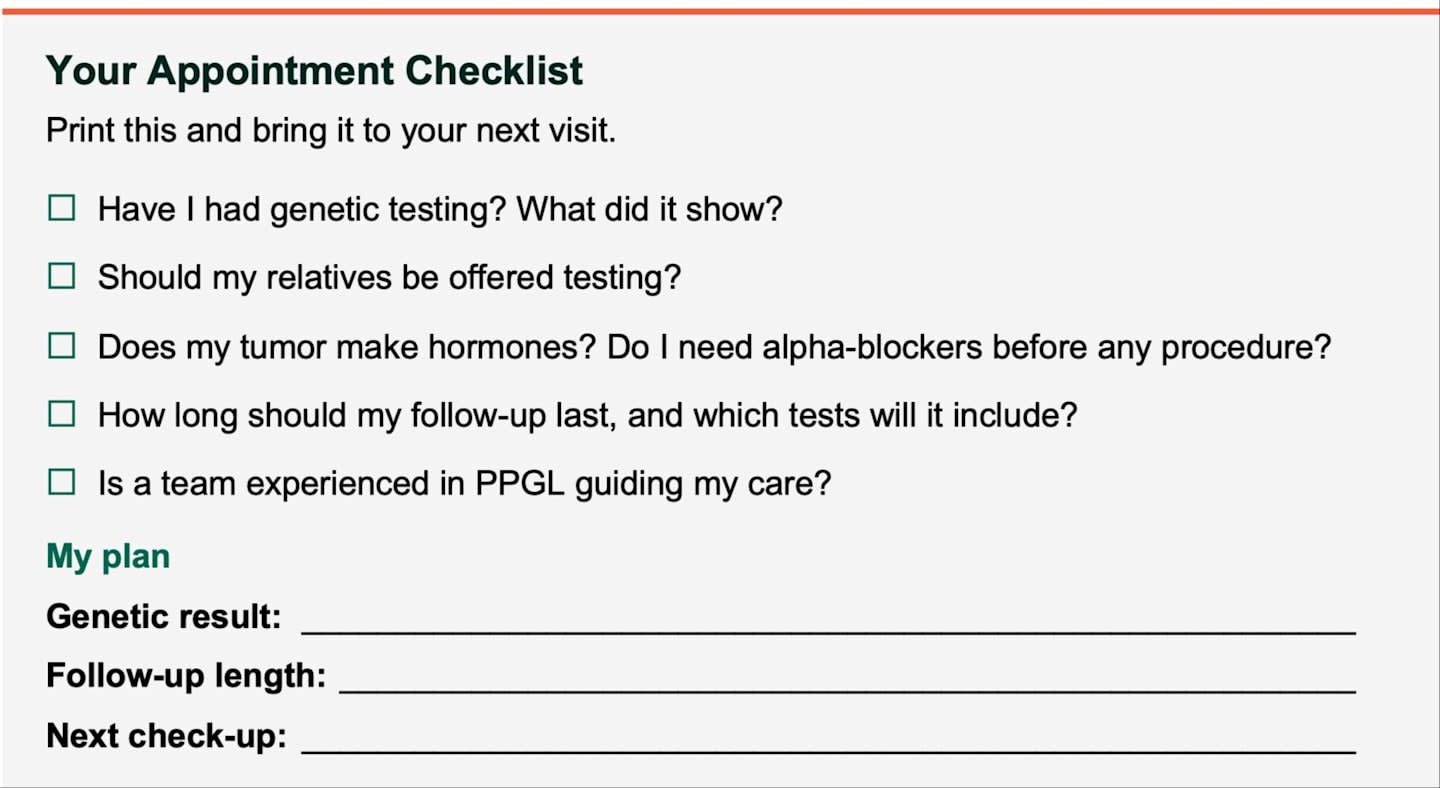 Read the full review, free: pmc.ncbi.nlm.nih.gov/articles/PMC13695349 References
Clinical Trials and Registry UpdatesEight New Studies Added to Our Clinical Trials Resource We've expanded our Find Clinical Trials page from 18 to 26 studies, reflecting additional research opportunities for people with PPGL. Two studies worth highlighting: RYZ401: A Phase 1 study evaluating an investigational alpha-particle radiopharmaceutical targeting somatostatin receptor-positive tumors. The sponsor has confirmed that eligible PPGL patients may be considered. ONC206 (JZP3507): A Phase 2 study specifically evaluating an investigational treatment for advanced PPGL, with multiple U.S. research sites. Our updated resource also includes studies investigating targeted therapies and other approaches. Clinical trial eligibility and recruiting status can change. We encourage patients to discuss potential opportunities with their healthcare teams and confirm details directly with study coordinators. Global Pheo Para Registry: Development UpdateDevelopment of the Global Pheo Para Patient & Provider Registry continues, with several important steps ahead. Our Research and Registry Advisory Board (RRAB) will meet with our Medical Advisory Board (MAB) to gather clinical input on the registry protocol and data dictionary, which will guide how we collect and organize information. Our team will also soon begin reviewing the informed consent materials to ensure participants have clear information about the registry and how their data may be used. By bringing together patient perspectives, clinical expertise, and research priorities, we're building a registry that can support meaningful PPGL research and improve our understanding of these rare diseases. We look forward to sharing more updates as development progresses. With Gratitude to Our Founding Registry SupportersWe are deeply grateful to the individuals and families whose generosity is helping establish the Global Pheo Para Patient & Provider Registry. Through gifts made in memory of loved ones, in honor of others, and in support of our mission, these founding supporters are helping build an important research resource for the PPGL community. Thank you for helping make this work possible. 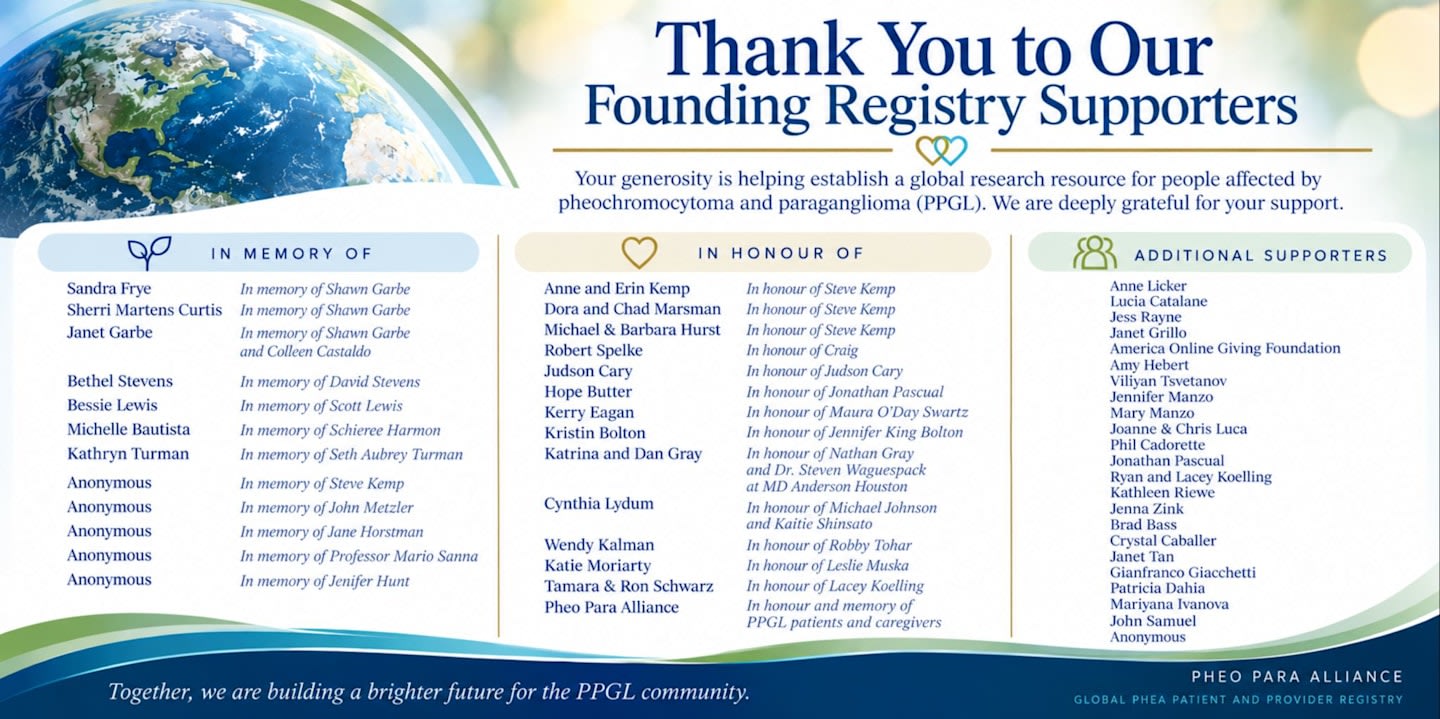 The Pheo Para Alliance's mission is to empower patients with pheochromocytoma or paraganglioma, their families, and medical professionals through advocacy, education, and a global community of support, while advancing research that accelerates treatments and cures. Patients, caregivers, clinician-scientists, and advocates founded us in 2007. The Pheo Para Alliance is a registered 501(c)(3) nonprofit organization, incorporated in the state of Virginia. Tax ID: 26-1510652. |